


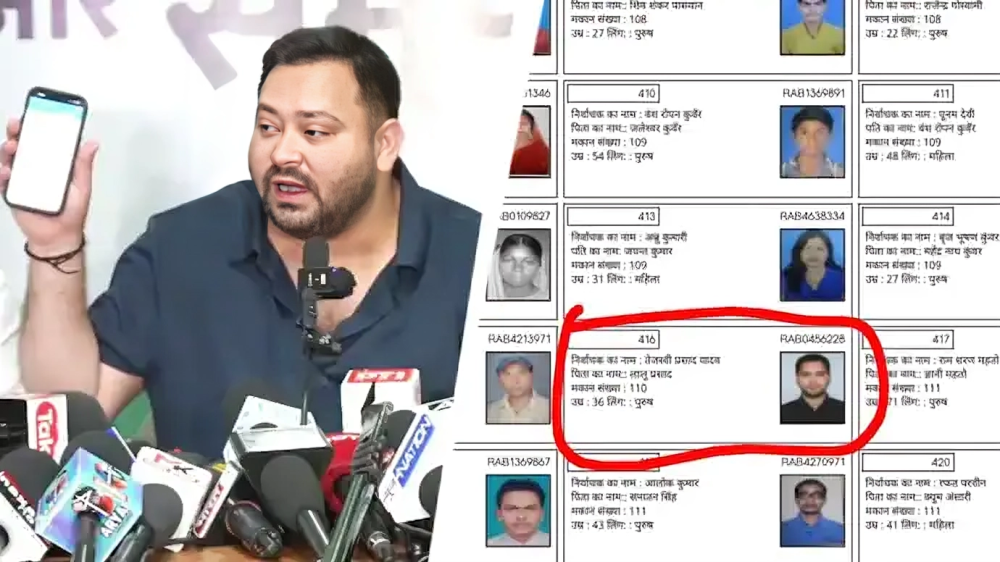
In a fresh political controversy from Bihar, Leader of Opposition Tejashwi Yadav has found himself facing allegations of possessing two separate voter identity cards with different numbers. The matter has sparked debates across political and legal circles, with questions being raised about electoral integrity, documentation authenticity, and political accountability.
The Allegations
The complaint was filed at the Digha police station in Patna by advocate Rajiv Ranjan. According to the complaint, Tejashwi Yadav is alleged to have two voter ID cards that bear different numbers. The allegation gained traction after the Rashtriya Janata Dal (RJD) leader recently displayed a voter ID at a press conference.
During the event, Yadav had claimed that his name was missing from the voter list, suggesting that this was an act of political targeting. However, the Election Commission of India (ECI) later clarified that the voter ID he showcased was not officially issued, raising serious questions about its authenticity.
Election Commission Notice
Following the incident, the ECI promptly sent a formal notice to Tejashwi Yadav. The notice seeks clarification on why he was in possession of an unissued voter ID and demands an explanation of how he obtained it. Such a situation, if proven true, could have legal implications under the Representation of the People Act, 1950 and 1951, which governs electoral rolls and fraudulent electoral practices.
The ECI has maintained that every voter in India is entitled to only one valid voter ID linked to their constituency and electoral roll entry. Having more than one voter card is a serious violation that can lead to penalties, including disqualification from contesting elections and criminal charges.
Political Reactions
The news has triggered mixed reactions in Bihar’s political landscape. Opposition parties have accused the ruling government of using the matter to target Tejashwi Yadav ahead of upcoming elections. They argue that the allegations are politically motivated and aimed at tarnishing his image.
On the other hand, rival political factions have demanded a thorough investigation. Some leaders have called for immediate FIR registration and a probe by a neutral agency to ensure transparency.
Legal Perspective
From a legal standpoint, the case revolves around two possible violations:
- Possession of multiple voter IDs – which is prohibited under electoral law.
- Possession of a forged or unissued government document – which could attract charges under the Indian Penal Code (IPC) for forgery and misrepresentation.
Advocate Rajiv Ranjan’s complaint, however, has not yet resulted in an FIR. The police have stated that they are currently verifying the documents and allegations before proceeding with formal registration.
Tejashwi Yadav’s Defense
Tejashwi Yadav has so far not made a detailed public statement regarding the allegations. His earlier comments during the press conference focused on his frustration over not finding his name in the voter list. According to him, this was a deliberate attempt to disenfranchise him and keep him from voting.
It is likely that his legal team will respond to the Election Commission’s notice within the stipulated time frame, providing their side of the story.
Broader Implications
This incident is not just about one political leader—it brings to the forefront broader issues regarding electoral record management in India. Duplicate entries, outdated records, and fraudulent IDs have long been challenges for the ECI.
If a high-profile leader can be caught in such a controversy, it raises concerns about the possibility of systemic loopholes that could be exploited by others.
Moreover, the case also sparks discussion on the role of public trust in democratic institutions. Voter ID cards are not only a tool for elections but also a form of identification used for various purposes, from banking to travel. Any compromise in their credibility directly impacts citizens’ confidence in governance systems.
What Happens Next?
The Election Commission’s notice is the immediate step in the case. Depending on Tejashwi Yadav’s response, the ECI may recommend further investigation or even initiate legal proceedings.
The police, on their part, will have to decide whether the complaint warrants an FIR and a criminal investigation.
The matter is likely to remain in public discourse over the next few weeks, especially with the election season approaching. Whether this will turn into a major political setback for Tejashwi Yadav or fade away as another minor controversy will depend on how the legal and political processes unfold.
Drunk Army Officer’s Reckless Driving Injures 30 in Nagpur